
Views: 0 Author: Site Editor Publish Time: 2026-04-22 Origin: Site


Investing in Stage Lighting goes far beyond simple aesthetics. It requires solving complex engineering, power distribution, and spatial challenges in demanding environments. You must easily differentiate between cheap, consumer-grade LEDs and true B2B-grade fixtures. High-end equipment guarantees long-term reliability, network scalability, and precise optical control under pressure. A failing light during a live broadcast is not just an inconvenience; it ruins the entire production value.
We designed this complete guide as a technical and commercial evaluation tool. It will help production managers, technical directors, and facility integrators properly align fixture capabilities directly to venue requirements and budget constraints. You will learn how to assess optical complexity, calculate total cost of ownership, and choose the exact fixtures required for a flawless production.
Professional stage lighting is categorized by optical complexity and movement capabilities (Static vs. Intelligent).
Evaluating Total Cost of Ownership (TCO) requires factoring in power draw, thermal management (HVAC load), and cable infrastructure, not just the fixture's sticker price.
The effectiveness of any lighting rig is heavily dependent on atmospheric pairings (hazers vs. foggers) and control protocol scalability (DMX512 vs. Art-Net/sACN).
Selecting the right fixtures relies on a 4-step framework: Stage Size, Event Type, Optical Needs, and Budgetary Constraints.
Treat lighting as a vital environmental control tool. It does much more than provide basic illumination. You use it to dictate exactly where the audience looks. Professional Stage Lighting defines stage geometry and isolates key performers.
Consider these core business and design factors before purchasing equipment:
Visibility vs. Focus: Broad visibility ensures the audience sees the stage. Precise focus directs their attention to a specific speaker or dramatic moment. You need different fixtures for each task.
Mood & Aesthetics: The psychological impact of color temperature and beam texturing dramatically shapes mood. Warm tones create intimacy. Stark cool whites convey high energy or tension.
The TCO Perspective: Traditional halogen and discharge lamps are largely obsolete. Modern venues rely on advanced LED ecosystems. While upfront hardware costs seem higher, long-term savings justify the investment. LEDs slash power consumption. They remove the need for constant gel replacements. They also drastically lower labor costs for maintenance. Furthermore, LEDs generate significantly less heat, which directly reduces your venue's HVAC cooling load.
We classify static fixtures by their optical complexity. They range from simple bare bulbs to highly engineered multi-lens systems. Understanding these mechanisms helps you choose the right tool for specific practical applications.
These fixtures represent the simplest optical design. They contain no lens and rely entirely on asymmetrical reflectors to shape the light. You use them to achieve broad, even light distribution across cycloramas and backdrops. They are highly cost-effective but offer zero beam control. You cannot focus a floodlight.
PAR cans are the workhorses of live events. Traditionally, they feature a sealed lamp, a reflector, and a lens combined into one unit. The sizing follows a strict mathematical rule based on eighths of an inch. For example, a PAR64 fixture is 8 inches in diameter (64 divided by 8). They provide cost-effective, high-output stage washes. Today, the industry has transitioned heavily to LED PARs. This shift allows for infinite color mixing without relying on fragile physical gels.
These fixtures introduce adjustable optical control. Fresnels use concentric ringed lenses to provide variable beam sizes, typically ranging from 10° to 55°. You use them to achieve smooth, soft-edged blending. They are perfect for front light and facial illumination in theaters and churches. Plano-Convex (PC) lights belong to the same family but use a different lens shape. A PC fixture produces a slightly sharper beam edge compared to the highly diffused edge of a Fresnel.
Profile fixtures, often called Lekos, offer the highest optical complexity among static lights. They feature internal framing shutters, interchangeable lens tubes (such as 19°, 26°, or variable zoom), and dedicated slots for Gobos (pattern templates). You use them for surgical precision lighting. They isolate performers perfectly. You can project sharp textures onto the stage without spilling light into unwanted architectural areas.
Moving lights act as the "Swiss Army Knife" of modern production. They offer incredible dynamic scalability. However, their internal mechanical complexity introduces significant maintenance trade-offs. You must clean and service them regularly.
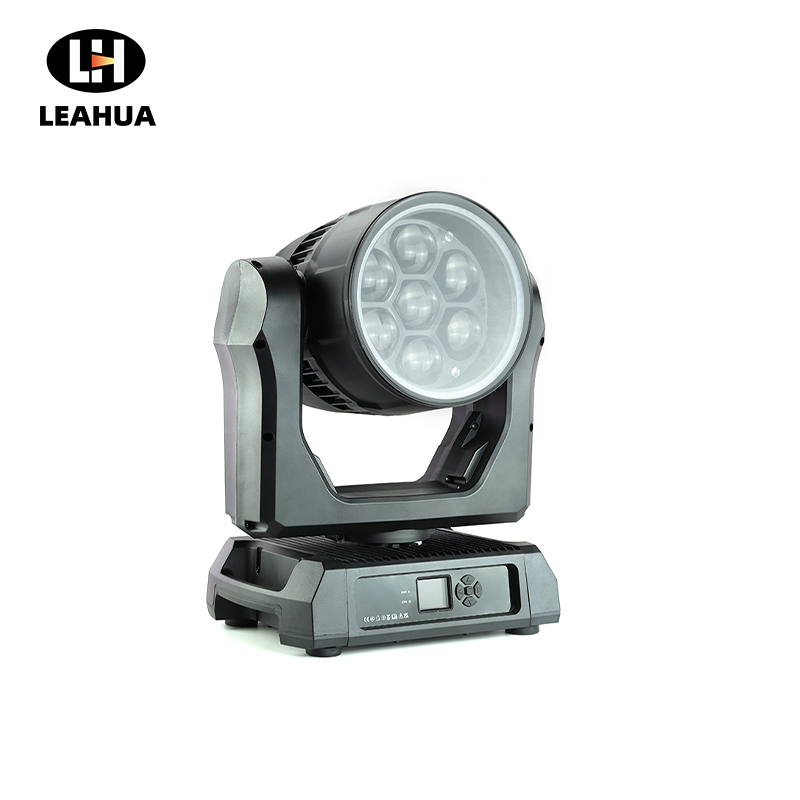
Wash fixtures produce soft edges and feature high-output color mixing, typically utilizing CMY (Cyan, Magenta, Yellow) or RGBW (Red, Green, Blue, White) LED engines. You use them to blanket moving target areas smoothly. They provide the vibrant colored backdrops seen in modern concert touring.
Spots deliver hard-edged beams. Manufacturers equip them with rotating prisms, animation wheels, and multiple Gobo wheels. You use them to create stunning aerial effects and sharp focal points on the stage floor. They add texture and movement to otherwise static scenes.
Beam fixtures feature extremely tight, laser-like projection angles, usually between 1° and 8°. Designers use them to cut through heavy ambient light and thick atmospheric effects. They are the defining visual element of high-energy live music and EDM festivals.
Hybrid fixtures attempt to combine Beam, Spot, and Wash functions into a single moving head. They are highly versatile, making them extremely popular for rental house inventories. However, you must understand the compromises. Budget hybrid models often lack full CMY color mixing. Additionally, when operating in Wash mode, they frequently suffer from a noticeable "hot-spot" in the center of the beam rather than a perfectly flat field of light.
Fixture Category | Primary Use Case | Beam Edge Quality | Maintenance Needs |
|---|---|---|---|
Fresnel | Front facial lighting, soft blending | Very Soft | Low |
Profile (ERS) | Precise isolation, Gobo projection | Hard / Sharply Defined | Low |
Moving Beam | High-energy aerial effects | Razor Sharp (1°-8°) | High |
Hybrid Moving Head | Multi-purpose rental inventory | Variable (Compromised Wash) | Very High |
Stage lighting fails completely without the right atmospheric environment and reliable data pathways. You can buy the most expensive moving heads, but they will look terrible if your infrastructure cannot support them.
Light is invisible in thin air until it hits a surface. You need atmospheric particles to see the beams in mid-air. You must understand the rigid difference between two distinct machines:
Hazers: These machines produce a fine, long-lasting mist. They use either mineral oil or water-based fluids. The haze hangs in the air invisibly until a light beam cuts through it. Hazers are mandatory for modern concert lighting.
Fog Machines: These machines dump dense, short-lived clouds of thick white smoke. You use them for brief special effects, not for sustained beam visibility.
Best Practice: Never mix fluid types. Putting water-based fluid into an oil-based hazer will destroy the heater core instantly and create toxic fumes.
Your lights need instructions. The data pathways you choose dictate the scale of your production.
DMX512: This remains the reliable industry standard. It runs over standard 5-pin XLR cables. However, it is strictly limited to 512 channels of data per "universe." Modern multi-channel pixel-mapped LED bars can easily max out a single universe with just two or three fixtures.
Art-Net & sACN: These are Ethernet-based protocols. They send DMX data over standard Cat5e/Cat6 network cables. They are absolutely necessary for large-scale, high-bandwidth rigs because they can handle thousands of universes simultaneously.
Do not ignore the engineering reality of hanging heavy equipment over people's heads. Cable management directly impacts safety. When mounting lights on moving trusses, you must use specialized cable carriers. Industrial zig-zag chains protect fragile data lines from snapping. Proper routing prevents signal failure, eliminates trip hazards on the deck, and drastically reduces electrical fire risks.
Buying lighting equipment without a strategy wastes money. Use this strict, actionable decision matrix to evaluate your next purchase.
Stage Size & Throw Distance: Calculate the exact distance from your mounting position to the stage. Short throw environments (like small club stages) require wide-angle Fresnels and LED Washes. Long throw environments (like arenas or mega-churches) demand high-wattage moving Beams and narrow-angle ERS profiles.
Event Type Constraints: Different events have opposing technical requirements. A church or broadcast theatre prioritizes fixtures with a high CRI (Color Rendering Index) for accurate skin tones. They also require silent cooling fans and ultra-smooth, flicker-free dimming. Conversely, EDM concerts prioritize fast pan/tilt speeds, aggressive strobe rates, and sharp beam contrast.
Budget & Integration Allocation: Always spend your core budget on reliable front-lighting first. Ensure your speakers and performers are perfectly lit using high-quality Profiles and Fresnels. Only after securing front-light should you invest remaining funds into flashy moving heads and effects.
Pilot Testing: Never buy a massive batch of LED fixtures blindly. Always buy one demo unit first. You must pilot test it to validate dimmer compatibility with your existing venue control boards. Mismatched dimming curves will ruin your show.
Even the best plans encounter technical realities onsite. You must know how to spot and fix common failure points quickly.
LED flickering is a notorious problem. It is usually caused by impedance mismatches between older, traditional dimming racks and modern LED power supplies. LEDs require constant power. If you plug a modern LED fixture into an old-school theatrical dimmer rack that is slightly leaking voltage, the light will pulse or flicker erratically. You must supply direct, unswitched relay power to intelligent LEDs.
Modern LEDs generate less ambient heat than halogen bulbs, but their internal microprocessors run extremely hot. Intelligent lights will fail, reboot randomly, or automatically dim themselves if rigged without adequate ventilation. Never install moving heads directly against a ceiling or inside an unventilated architectural cove.
Beware the risk of buying cheap LEDs over a long period. Different manufacturing batches yield varying white-light color temperatures. This is known as a "binning" issue. If you buy ten cheap LED washes this year and ten more next year, the "white" outputs will look entirely different side-by-side. Always use dedicated light meters to verify consistency. Professional B2B manufacturers guarantee tight color binning across their entire product lifespan.
Sourcing equipment is an exercise in balancing precise optical requirements, data infrastructure capacity, and budget realities.
Prioritize your foundational static fixtures for front lighting before investing heavily in complex moving heads.
Factor in the total cost of ownership. Evaluate power draw, HVAC load reduction, and maintenance labor.
Respect the invisible infrastructure. Invest in high-quality networking protocols (Art-Net/sACN) and proper atmospheric machines (hazers) to maximize your visual impact.
Your next step is practical action. Conduct a comprehensive audit of your current power availability and network data infrastructure. Once you know your facility's limits, consult with a technical lighting designer to plot a scalable CAD layout before issuing any major purchase orders.
A: A Wash light produces a wide, soft-edged pool of light used to smoothly cover large stage areas and blend colors seamlessly. A Spot light produces a narrow, hard-edged beam. You use spots to focus intensely on specific performers or to project sharp patterns (Gobos) onto surfaces.
A: Yes, in almost all modern applications. While LEDs carry a higher upfront cost, they offer a vastly superior Total Cost of Ownership (TCO). They consume much less power, generate less heat, require zero gel replacements for color changing, and eliminate expensive bulb replacements.
A: Churches should prioritize high-CRI, silent LED PARs and soft Fresnels for broadcast-friendly face lighting. Because video streaming is common, ensuring flicker-free, accurate skin tones is paramount. Simple moving Washes can be added later to gently color the background without distracting the congregation.
A: DMX stands for Digital Multiplex. It is the universal digital communication standard used to control lighting equipment. You need a DMX controller to centralize and automate the intensity, color mixing, and physical movement of every fixture in your rig from one location.


