
Author: Leahua Lighting Publish Time: 2026-05-29 Origin: Site


Stage lighting has transformed dramatically over the decades, evolving from simple static fixtures into highly automated, multi-parameter intelligent robotic systems. Today, dynamic productions depend heavily on these advanced networks to craft immersive, unforgettable visual experiences. However, navigating the underlying technology can feel daunting for technical directors, procurement managers, and lighting designers. Grasping this technology goes far beyond a simple mechanical teardown. It serves as a vital technical blueprint for properly evaluating, specifying, and deploying intelligent fixtures for live events or permanent installations.
In this guide, you will learn exactly how these devices process raw energy and data to create targeted optical outputs. We will explore the hardware differences between various optical profiles to help you choose the ideal fit for your venue. Finally, we will uncover the critical DMX programming protocols, rigging safety metrics, and deployment realities professionals rely on daily.
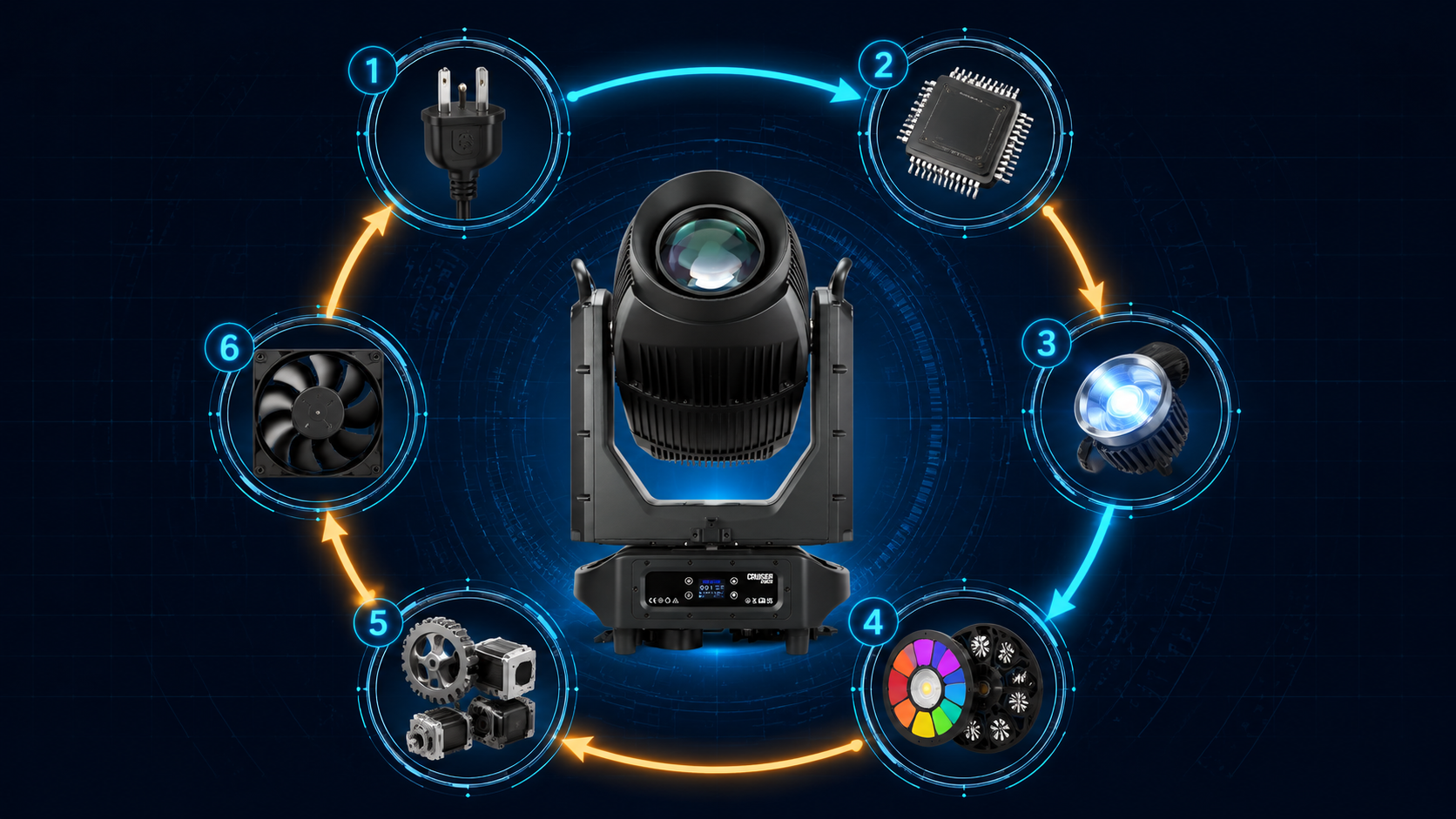
Mechanical Flow: Moving head lights function through a 6-step internal process transforming raw AC power and DMX data into targeted optical output.
Power Vulnerability: Plugging a moving head into a traditional AC dimmer circuit will irreversibly destroy its internal motherboard.
Strategic Sourcing: For small venues or initial investments, "Wash" fixtures offer significantly higher ROI than "Beam" or "Spot" models.
Scalable Control: Professional workflows rely on DMX mapping and control console "Palettes" to ensure programmed scenes (Cues) adapt instantly to new venue dimensions.
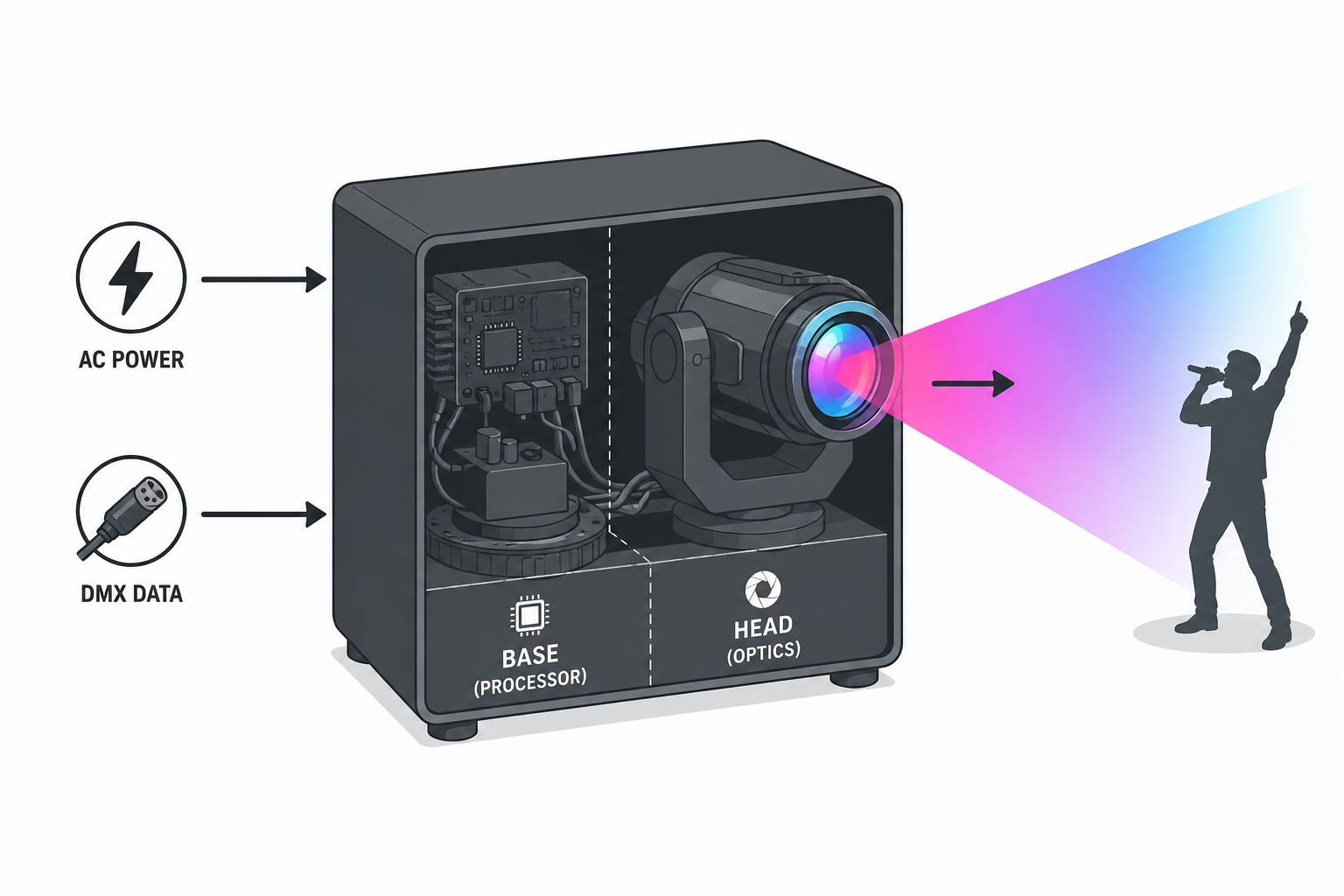
You can treat an intelligent fixture like a black box processing energy and data. Engineers generally divide the hardware into two main sections: the base housing the processing units, and the moving head (often called the egg) housing the optical array. Understanding this internal flow helps operators prevent catastrophic hardware failures.
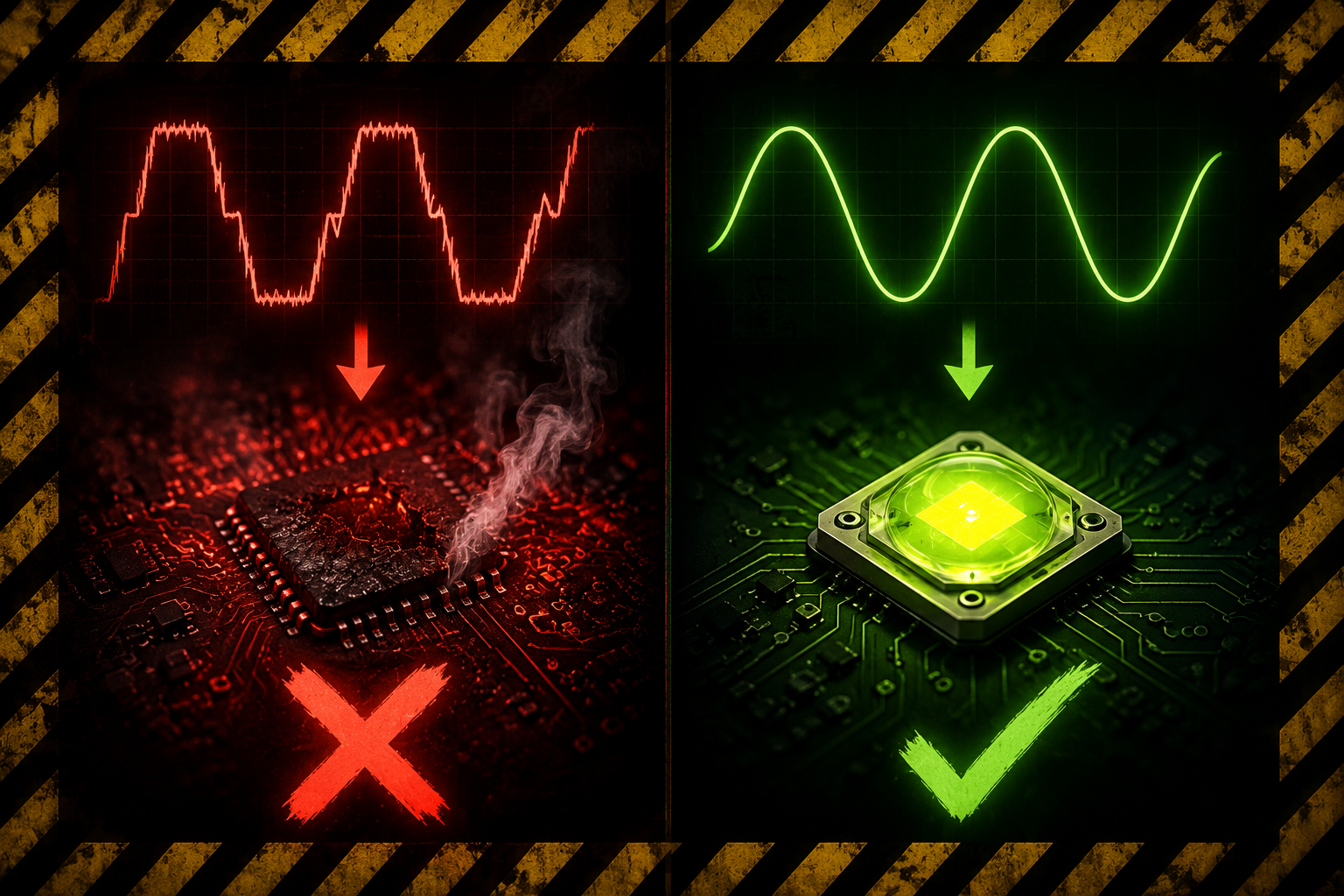
You must connect these fixtures strictly to non-dim AC power. Traditional theatrical dimmers operate by truncating sine waves to reduce voltage. If you route this chopped power into an automated fixture, you will instantly burn out the internal logic board and power supply. Always use direct wall power or dedicated relay packs.
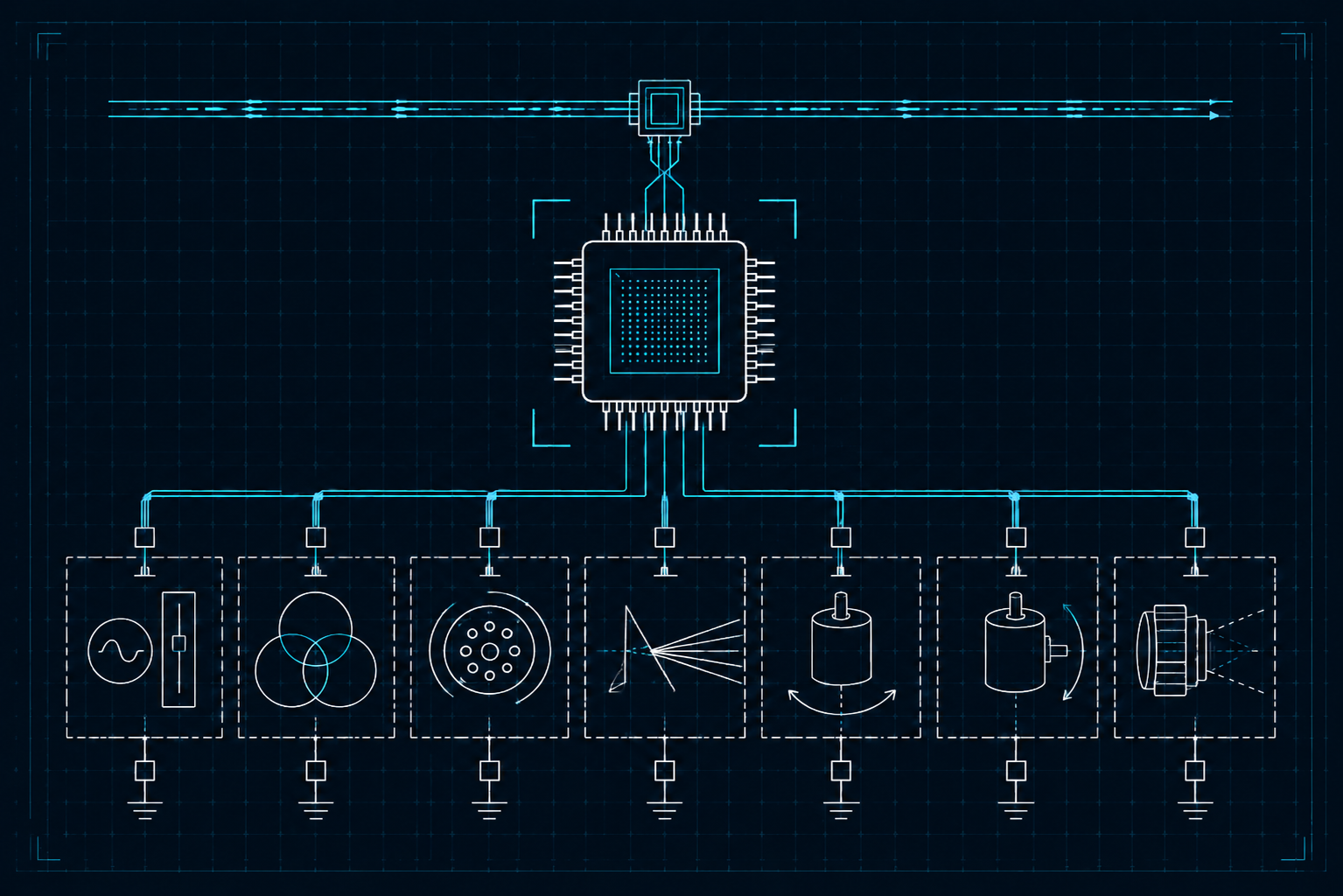
The base receives control signals, typically via DMX512 or Art-Net protocols. An internal processor reads this data stream and assigns specific multi-channel parameters to corresponding fixture functions. This computer translates digital commands into precise voltage adjustments for dozens of internal motors.
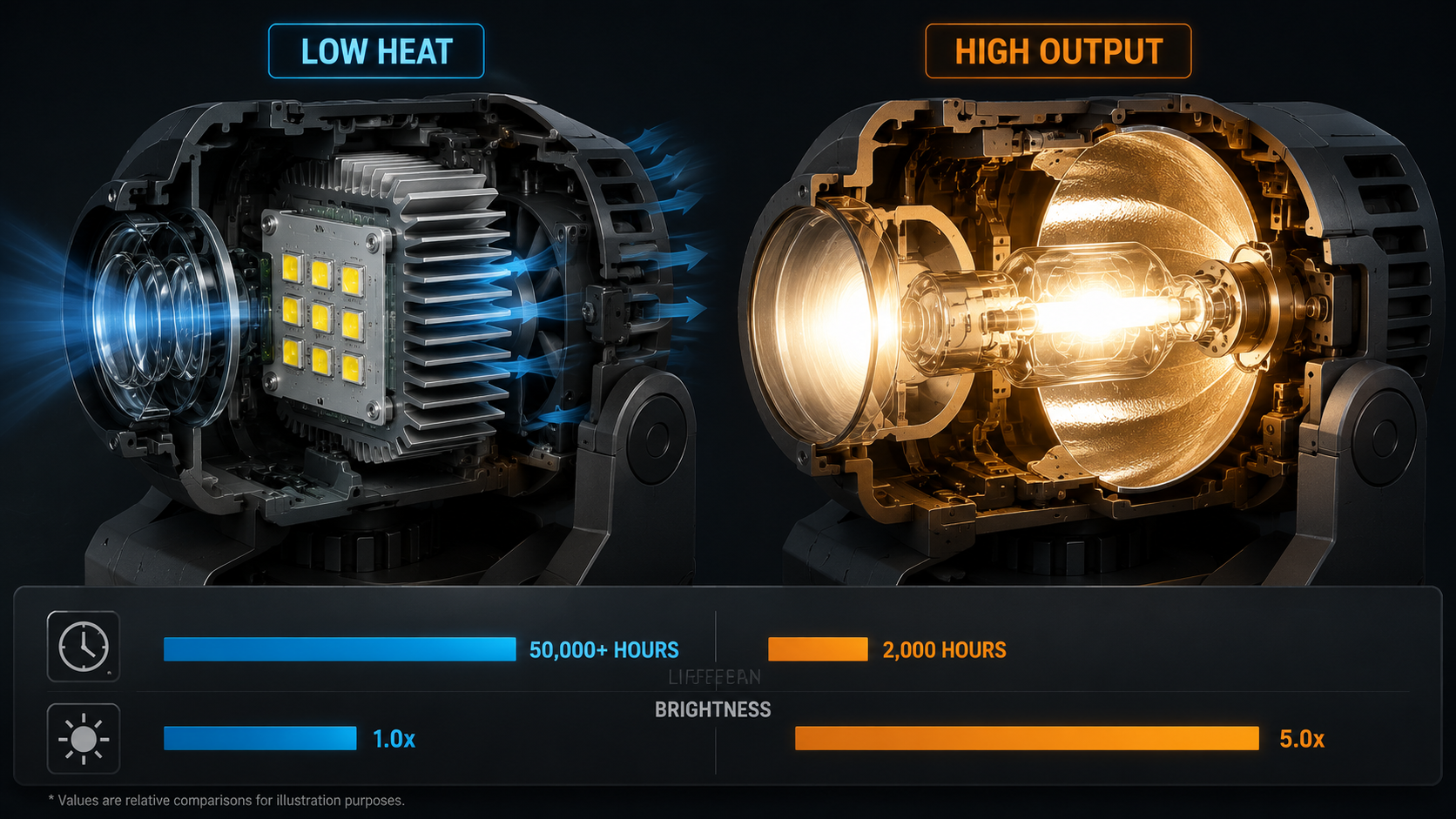
The system activates the primary light source. Modern units heavily favor LED engines because they run cooler and operate more efficiently. Conversely, high-output HMI or HID gas discharge lamps remain common in massive stadium rigs. Because operators cannot electronically dim gas discharge lamps, these units rely on mechanical shutters to control brightness.
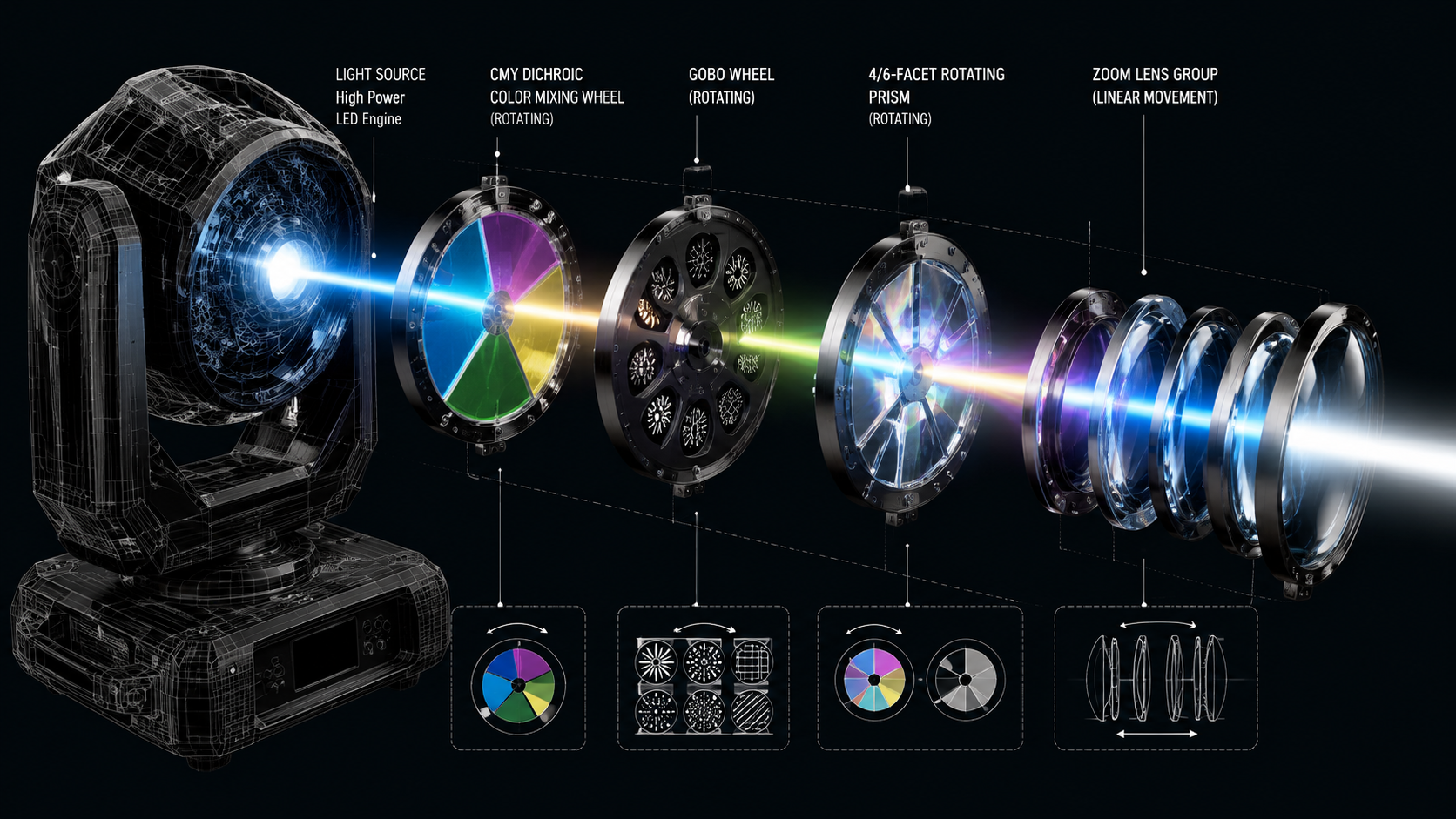
Raw light travels through a complex series of internal modules. It passes through CMY subtractive color mixing flags, which slide dichroic glass filters into the beam path to blend infinite hues. The beam then strikes fixed color wheels, rotating Gobos (pattern templates), and multi-facet prisms to shape the final projection.
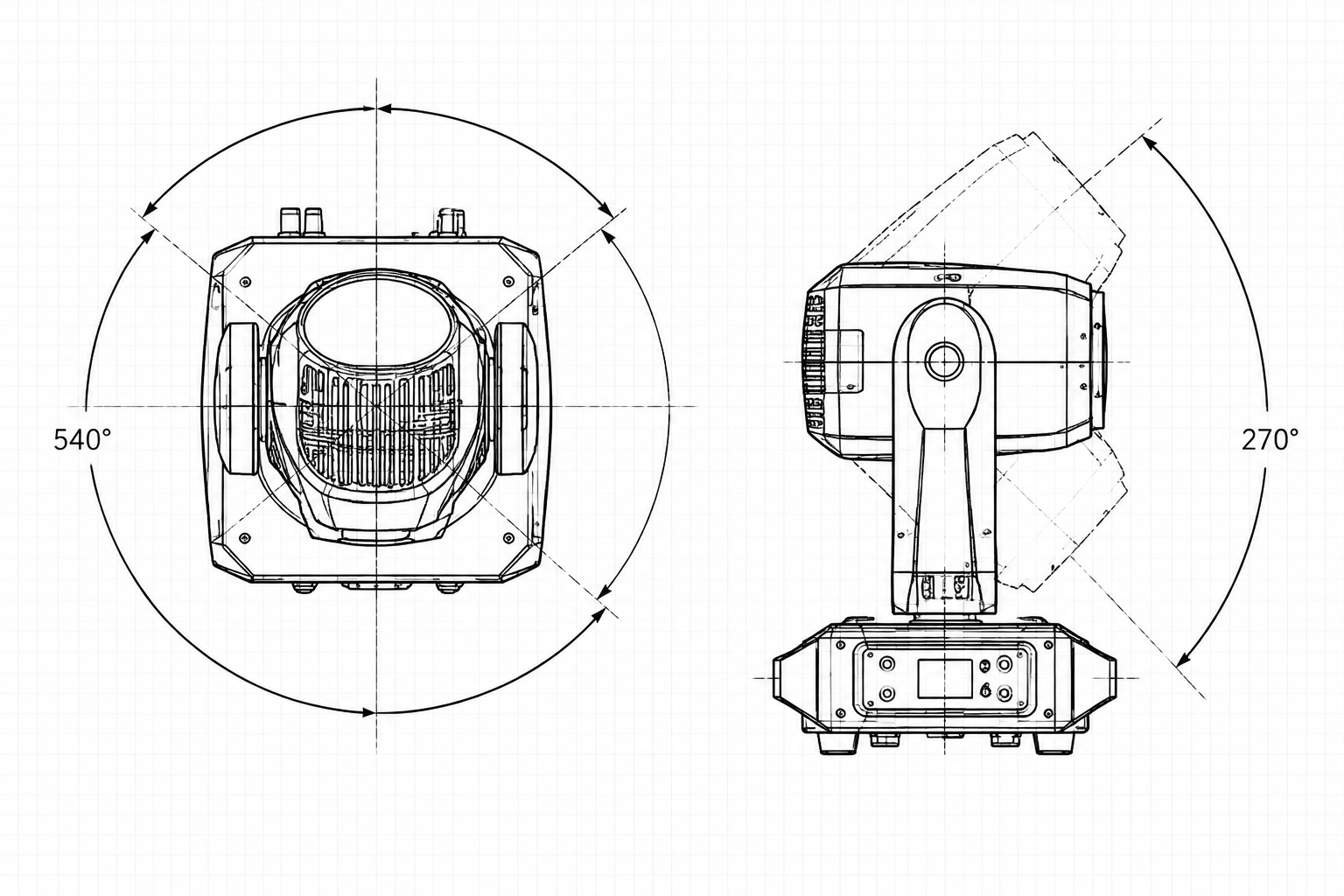
High-torque stepper motors physically drive the fixture. The yoke mechanism controls the pan, typically rotating 360° to 540°. Meanwhile, secondary motors control the head's tilt, usually offering 180° to 270° of motion. These motors use precise digital encoding to ensure accurate, repeatable movements.
Intense light sources generate massive heat. Active cooling relies on internal fans and aluminum heat sinks to disperse this thermal load. Proper cooling prevents sudden thermal shutdowns and protects extremely sensitive dichroic glass components from shattering.
| Process Step | Primary Component | Critical Function |
|---|---|---|
| Power Delivery | Power Supply Unit (PSU) | Requires pure, un-dimmed AC voltage. |
| Data Processing | Logic Motherboard | Translates DMX/Art-Net into motor commands. |
| Source Activation | LED Engine / HID Lamp | Generates the raw photon output. |
| Optical Manipulation | CMY Flags, Gobos, Prisms | Shapes, colors, and textures the beam. |
| Mechanical Positioning | Stepper Motors | Executes pan (360°+) and tilt (180°+) movements. |
| Thermal Management | Fans & Heat Sinks | Prevents overheating and glass shattering. |
Hardware Evaluation: Choosing Between Beam, Spot, and Wash Profiles
Technical directors constantly face a buyer's dilemma when selecting the right optical class. Matching fixture optics to specific stage requirements ensures you build a versatile, highly effective lighting rig.
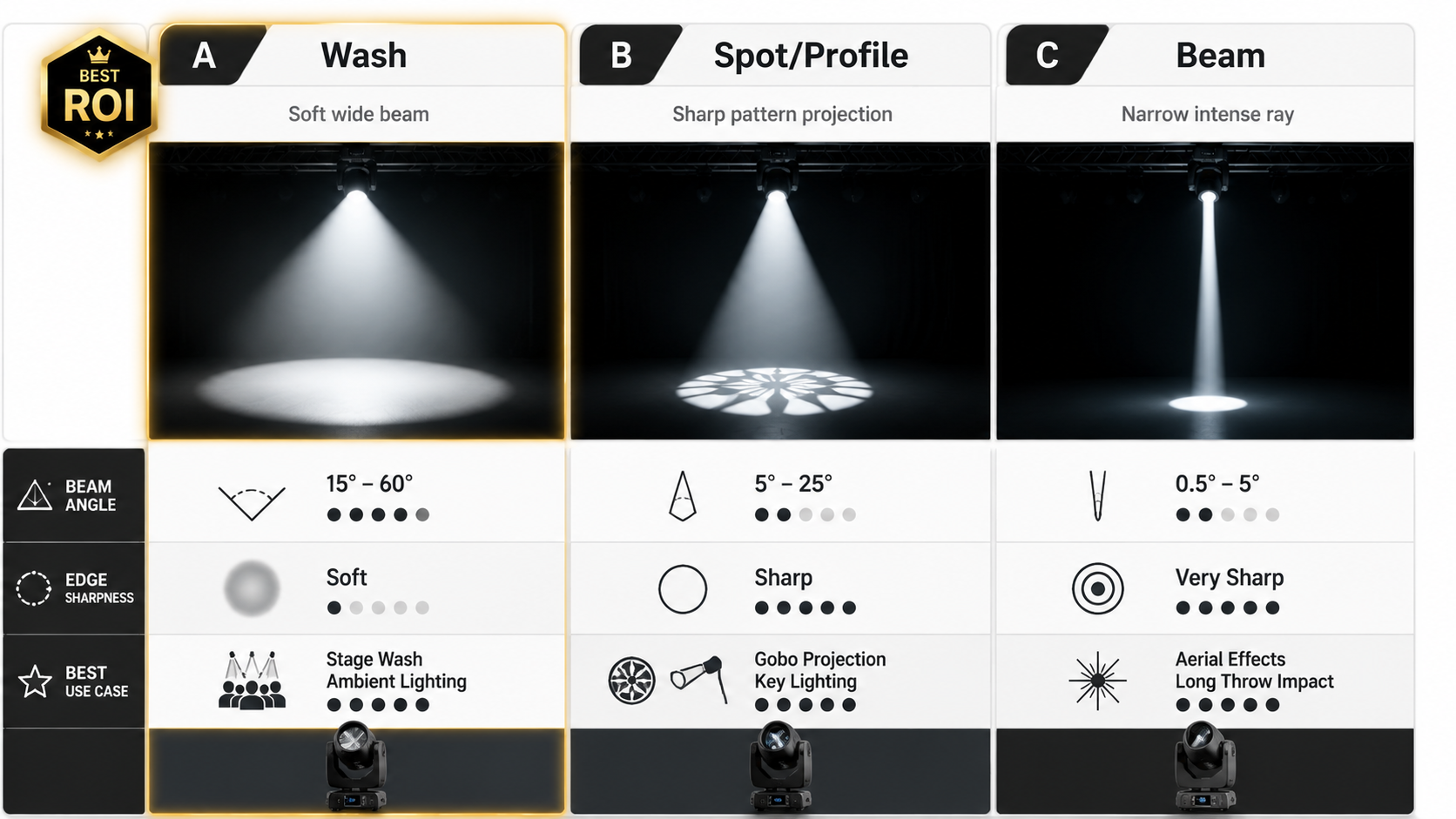
Mechanism: Wash fixtures utilize wide lenses, often featuring multi-LED arrays, to produce a soft-edged, widely spread beam. They provide uniform color coverage across large areas.
Implementation Reality: These represent the most practical initial investment for small stages or corporate venues. Base visibility stands as priority number one. Before adding flashy effects, you must ensure your presenters or performers remain clearly illuminated.
Mechanism: Spot fixtures feature precise focal lenses, rotating Gobo wheels, and variable zoom capabilities. "Profiles" take this a step further by adding internal framing shutters. These metallic blades physically cut light away from projection screens or set pieces.
Implementation Reality: These units excel at projecting brand visual identities, such as crisp corporate logos. They also define stage depth by casting textured patterns across floors and backdrops.
Mechanism: Beam fixtures emit a micro-angle, laser-like shaft of light. They use specialized optics to keep the beam incredibly tight over long distances.
Implementation Reality: These units prove largely useless without atmospheric haze or fog. When suspended in a hazy room, they create spectacular mid-air architectural effects. Planners reserve them primarily for high-energy concert touring or EDM venues.
Mechanism: Scanners employ a rapidly moving external mirror to direct the light beam, rather than moving the entire heavy head.
Implementation Reality: Because only a lightweight mirror moves, scanners execute much faster directional changes. Furthermore, they require zero clearance for head rotation. This makes them ideal for basement clubs or venues battling restrictive rigging heights.
Operating a fleet of intelligent lights requires a sophisticated control strategy. The "brains" behind the operation depend on strict data management and scalable programming practices.
A traditional static light needs just one control channel to adjust intensity. Conversely, a single Moving Head Lights fixture requires anywhere from 15 to over 30 DMX channels. These individual channels control pan, tilt, cyan, magenta, yellow, gobo rotation, prism indexing, and focus.
This complexity demands strict address mapping. A standard DMX universe contains exactly 512 channels. If you assign fixture A to start at channel 1 (occupying 20 channels), fixture B must start at channel 21. Overlapping these addresses causes erratic fixture behavior, as two different lights attempt to interpret the same data stream.
Modern lighting consoles manufactured by industry leaders like MA Lighting, High End Systems (Hog), and ETC simplify this massive data load using "Palettes." Operators create Palettes as foundational building blocks—such as setting a specific "Lead Singer Position" or saving a perfect "Corporate Brand Blue."
Programmers then use these Palettes to build "Cues," which form the actual sequenced lighting show. This workflow provides a massive scalability benefit. In touring environments, operators simply update the base Palette at a new venue. Automatically, every Cue referencing that Palette updates instantly, saving hours of tedious reprogramming.
Even the most perfectly programmed show will fail if the physical deployment introduces safety hazards or data bottlenecks. Industry-standard practices exist to mitigate these exact risks.
Suspending heavy robotic equipment above an audience carries immense liability. Standard load safety protocols require a minimum 2:1 rigging margin. Considering these fixtures weigh between 15 and 50 lbs each, structural integrity remains non-negotiable.
Optimal hang heights dictate lens spread efficiency. For small rooms and clubs, target an 8 to 12-foot clearance. For larger concert halls, mount units between 15 and 25 feet high. Hanging a wide wash light too low will blind the audience, while hanging it too high dilutes its intensity.
When wiring fixtures, technicians daisy-chain the DMX signal from one unit to the next. You must always cap the final fixture in this chain utilizing a DMX terminator. This simple 120-ohm resistor absorbs the digital signal at the end of the line.
Leaving a DMX line un-terminated causes signal bounce. The digital data reflects back up the cable, colliding with new incoming signals. This data corruption results in random strobing, flickering colors, or wildly uncontrolled motor movements.
Operators frequently cause avoidable hardware failures by mishandling the power-down sequence. When using Arc or Discharge lamps, you must "strike off" the bulb via the DMX console first. However, you must leave the actual unit powered on.
This allows the internal cooling fans to run for an additional five to ten minutes. Moving a hot fixture before it cools down easily shatters the brittle dichroic glass lenses and destroys halogen components inside the egg.
Procurement managers and technical directors need a strict evaluation lens when shortlisting new equipment. Focusing purely on dazzling effects often leads to poor integration and hardware incompatibilities.
Decision makers must carefully evaluate the operational longevity of the light source. Modern LED engines reliably deliver 30,000 to 50,000 hours of continuous use while maintaining a exceptionally low power draw. In contrast, traditional discharge lamps require frequent, complex bulb replacements and consume massive amounts of AC power. Factoring in these efficiency metrics prevents unexpected maintenance hurdles down the road.
For corporate events, color accuracy directly impacts visual identity compliance. Do not settle for simple static color wheels. Instead, prioritize fixtures equipped with premium CMY subtractive mixing systems. These systems allow lighting designers to precisely match strict Pantone corporate brand guidelines, ensuring the stage perfectly reflects the client's official marketing materials.
A fixture is only as useful as its ability to communicate with your broader network. Verify full compatibility with your current control infrastructure, checking for native support of Art-Net, sACN, and wireless DMX protocols.
Furthermore, investigate the manufacturer's software ecosystem. Ensure they provide routine firmware updates. These updates prove critical for optimizing stepper motor algorithms, patching control bugs, and unlocking new functionality long after the initial deployment.
Moving head lights function as highly complex, network-dependent robotic systems. Mastering their deployment requires balancing artistic vision with rigid technical protocols. A successful stage design relies equally on choosing the appropriate optical class—knowing when to utilize a Wash versus a Spot—and adhering strictly to unyielding power and data infrastructure rules.
Audit Your Power: Verify your electrical tie-ins bypass all dimmer racks to protect sensitive internal motherboards.
Match the Optic to the Room: Prioritize Wash fixtures for foundational visibility in small venues before investing in atmospheric Beam effects.
Protect the Data Chain: Always deploy 120-ohm terminators at the end of every DMX run to guarantee signal integrity.
Cool Down Properly: Mandate a strict 10-minute fan-only cooling period for all discharge fixtures before physical strike and load-out.
A: This behavior typically indicates a digital communication error, not a broken motor. It is usually caused by a missing DMX terminator at the end of your cable run, or a DMX address overlap where two fixtures are trying to read the same data channel.
A: The unit was likely plugged into an active theatrical dimmer pack. Dimmer packs alter the electrical sine wave to reduce brightness. Intelligent fixtures require constant, un-dimmed relay or wall power to operate their internal computers safely.
A: For discharge fixtures, check if the ignitor has failed or if the bulb has reached the end of its life. For LED units, verify your control console has the mechanical shutter channel open and the master dimmer channel turned up via DMX.
A: For Wash lights illuminating people or scenery, no. However, for Beam and Spot fixtures, atmospheric haze or fog is absolutely mandatory if you want the audience to visualize the actual light shaft suspended in mid-air.


