
Author: Leahua Lighting Publish Time: 2026-05-22 Origin: Site


| Table of Contents |
4.3 Deep Drying and Controlled Assembly in Production 4.4 User-Side Proactive Maintenance: Vent Cleaning and Desiccant Renewal |
In the demanding world of professional stage lighting, fixtures deployed for outdoor festivals, concert touring, and large-scale architectural installations are expected to withstand torrential rain, extreme humidity, soaring heat, and abrasive dust day after day. An IP65 or even IP66 rating has become the standard admission ticket for any fixture entering this arena. Yet as a manufacturer dedicated to outdoor entertainment lighting, we consistently hear the same frustrations from production teams and lighting designers: "The light kept the rain out, but after just one season, the output has visibly dropped." Or, "There's a stubborn fog inside the lens ruining the beam quality." These scenarios expose a critical truth that every lighting technical engineer must grapple with: keeping liquid water out is merely the first step. The true measure of a professional fixture is its ability to deliver stable output and uncompromised luminous efficacy over its entire lighting life.
The threats to long-term, stable light output in an outdoor waterproof fixture don't come from a direct downpour. They come from two interlinked, chronic conditions festering inside the sealed housing: a thermal bottleneck that triggers power degradation and lumen depreciation, and internal condensation that erodes both optics and electronics.

LED sources used in entertainment lighting convert only about 35% to 45% of electrical energy into visible light; the rest becomes heat. The very seals that make a fixture waterproof also eliminate natural air convection, forcing all heat to dissipate passively through the chassis. When this heat isn't extracted quickly enough, the LED junction temperature spikes dramatically.The resulting damage is a cascade failure. The most immediate effect is a drop in luminous efficacy: for typical high-power white or color LEDs, the light output can decay by 1% to 3% for every 10°C rise in junction temperature. Concurrently, the driver's thermal protection circuit aggressively reduces drive current to prevent catastrophic failure. On a concert touring stage, this translates to a fixture whose brightness fades exactly when it's needed most — during that high-impact, full-output cue. The deeper, more insidious damage is irreversible lumen depreciation. Chronic high-temperature operation accelerates the degradation of the LED chip and phosphor layer, causing permanent color shift, rendering index drift, and a non-recoverable loss of overall brightness in just a few hundred hours. For any lighting design relying on precise color matching, this is an unacceptable failure.
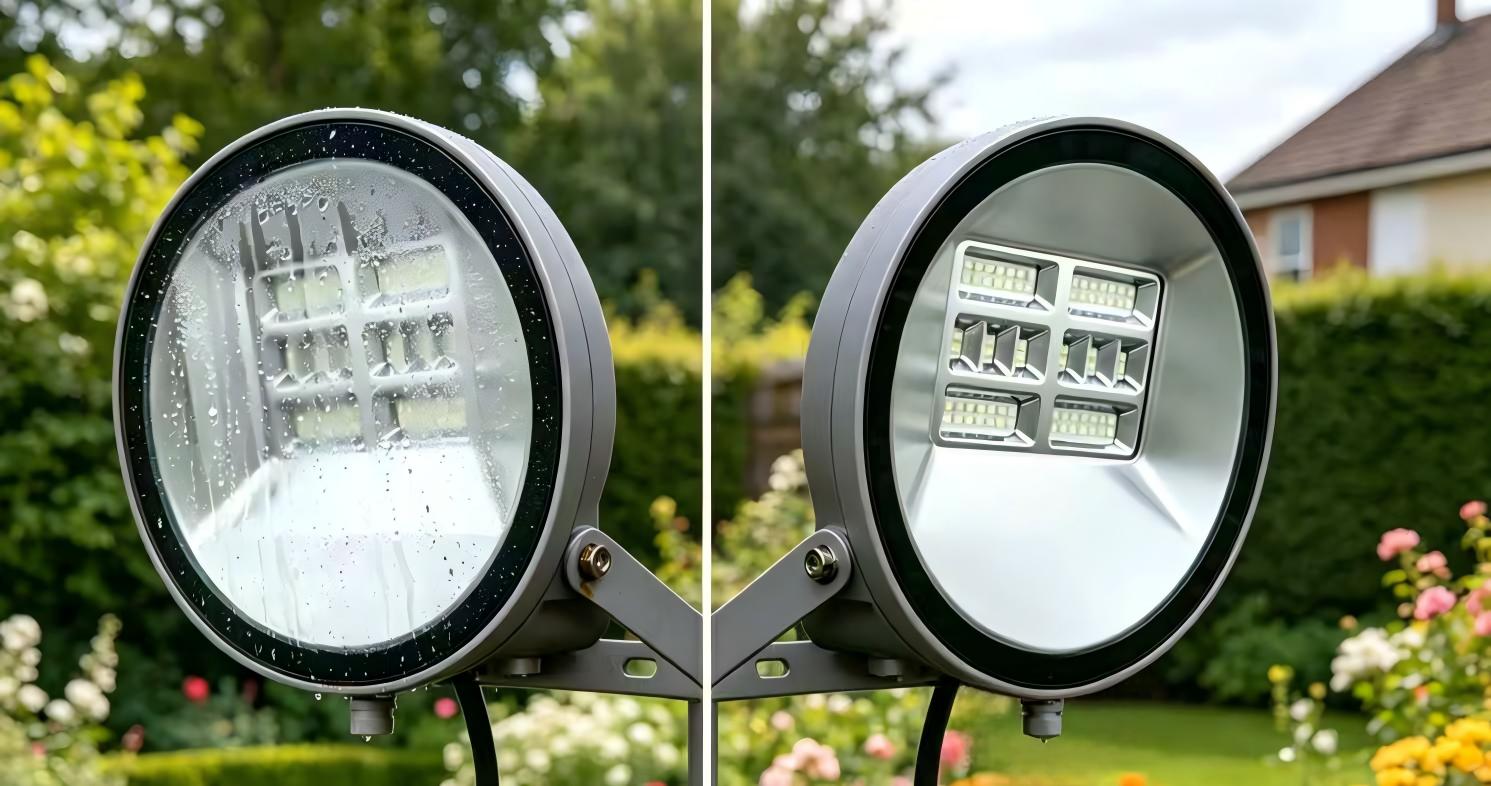
If heat is a slow, draining tax on performance, condensation is an unpredictable, acute injury. Drastic temperature swings between day and night, along with the "breathing effect" induced by intermittent operation, actively draw moisture-laden air into the sealed housing. When the temperature of an internal optical surface — a lens, a reflector, a gobo — falls below the air's dew point, water vapor condenses into a microscopic, fog-like film. This layer can instantly steal 10% to 30% of beam transmission and destroys the sharpness of a projection, turning a crisp gobo pattern into a blurry shadow. For a finely crafted lighting design, this is a visual catastrophe.
The destruction doesn't stop at the optics. Micro-droplets settling on circuit boards, connectors, and LED pins are the starting point for electrochemical corrosion. This leads to leakage currents, intermittent shorts, and chaotic DMX signal errors that can drive a production team to frustration during a show-critical moment. If condensation occurs repeatedly, the corrosion spreads, evolving a once-reliable fixture into a permanently damaged asset with a drastically shortened lighting life.
Solving these problems requires a clear-eyed look at the physical realities inside a waterproof fixture.
Common Thermal Design Pathways
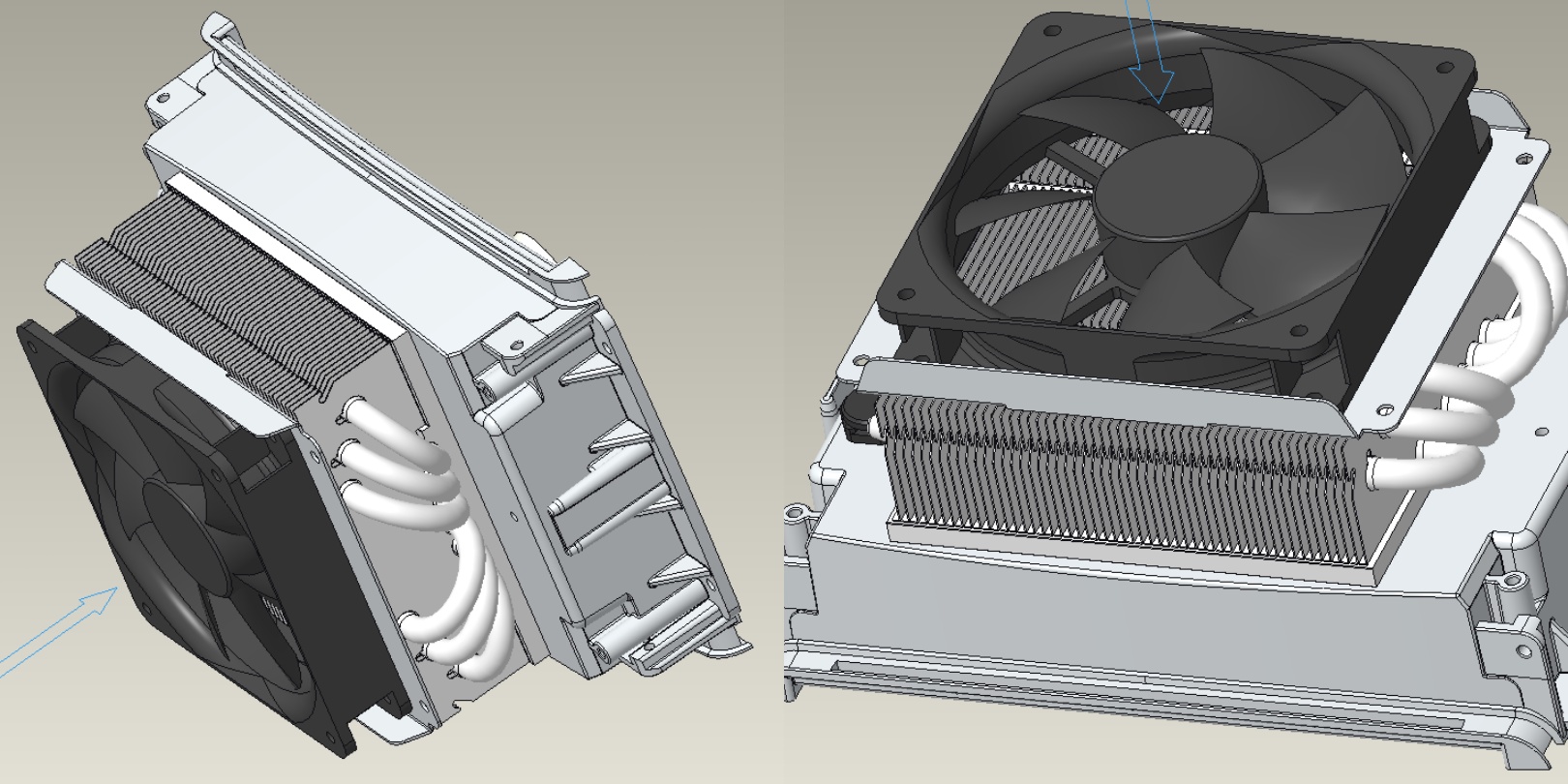
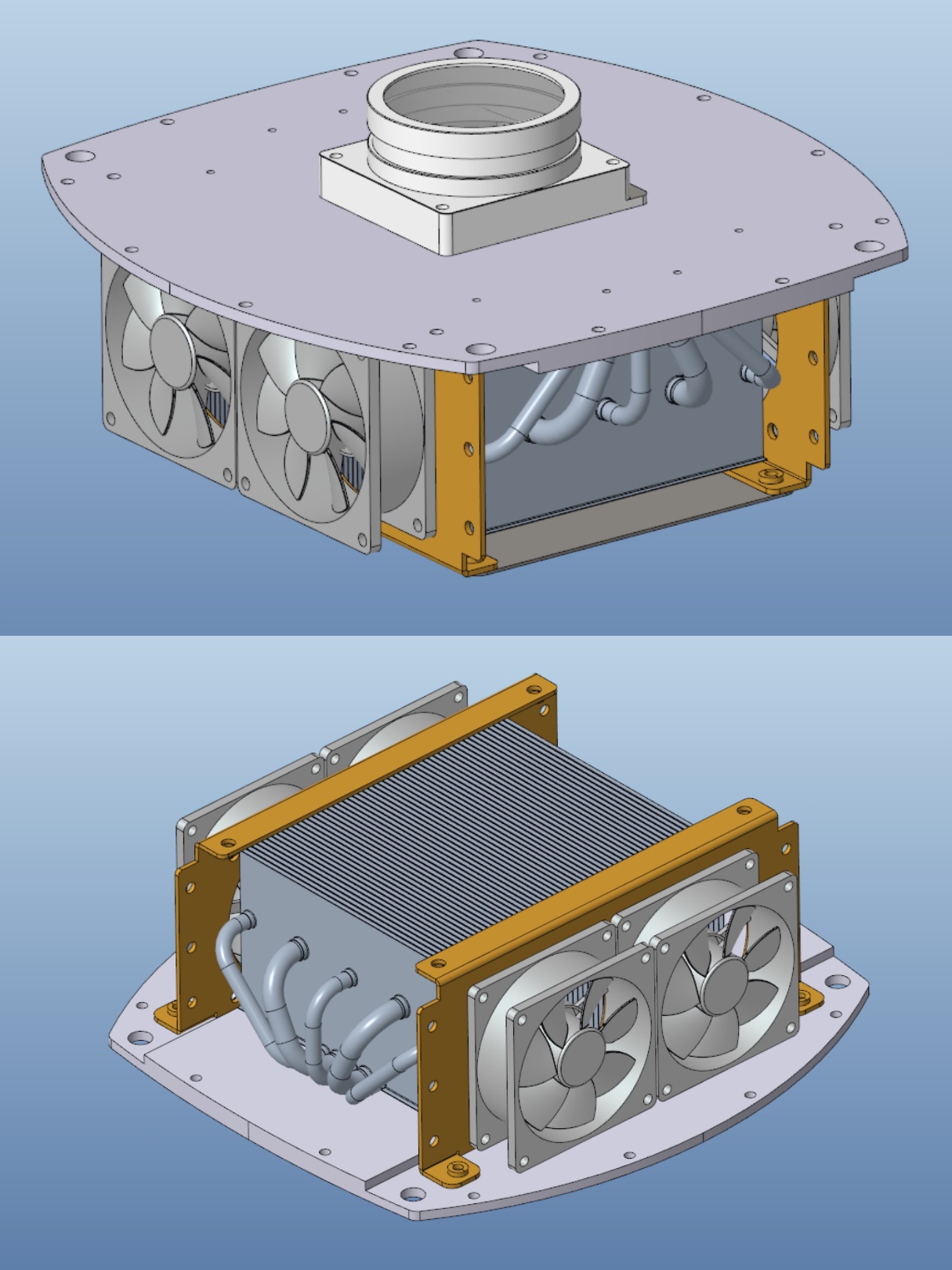
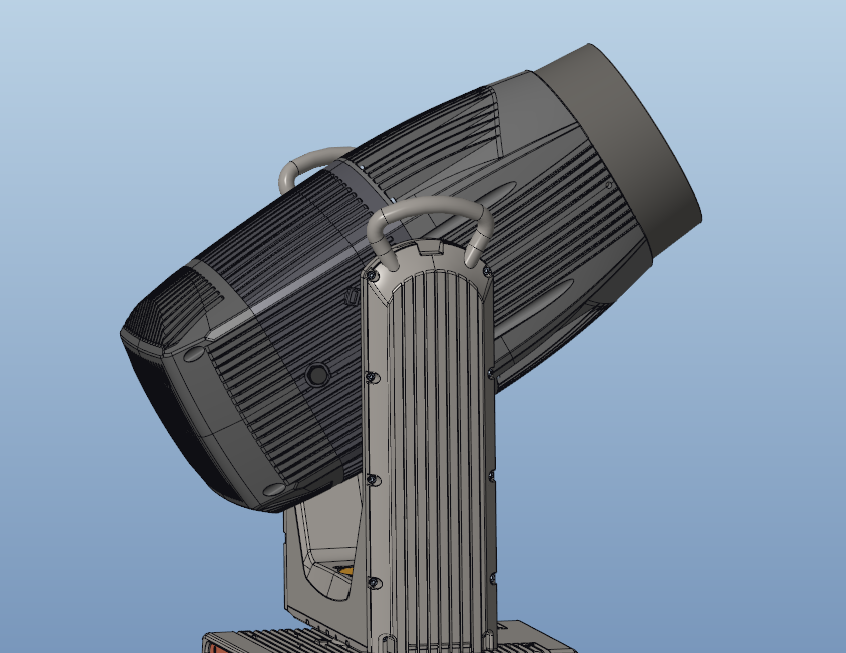
Today's outdoor stage lighting typically relies on a one-piece die-cast aluminum housing, frequently augmented with copper heat pipes or vapor chambers to rapidly spread heat from the source to large cooling fins. Some high-powered moving heads add an internal circulation fan to stir the sealed air and reduce hot spots. The fatal flaw in these systems emerges when the fin area is insufficient, thermal interface materials degrade, or the external ambient temperature soars. The heat has no escape path, and the fixture enters a state of thermal saturation, forcing every electronic and optical component to operate at its worst possible condition.
The True Mechanism of Condensation — The "Breathing" Trap
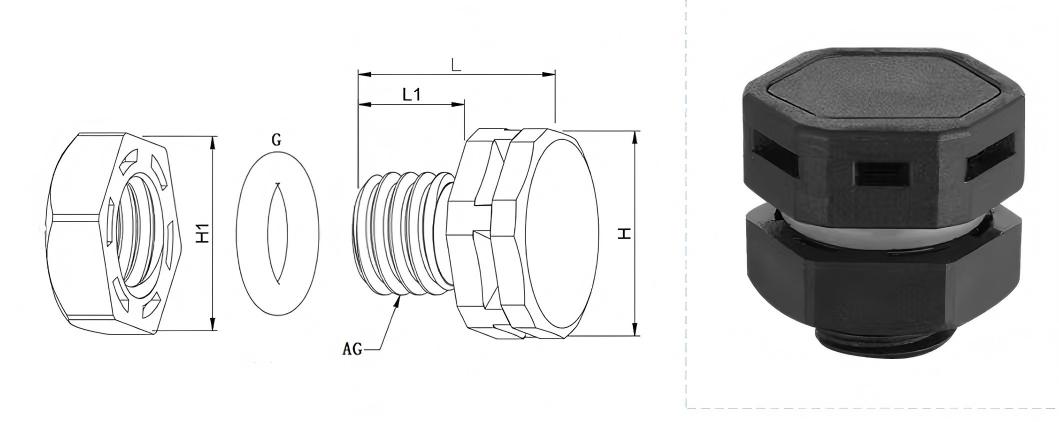
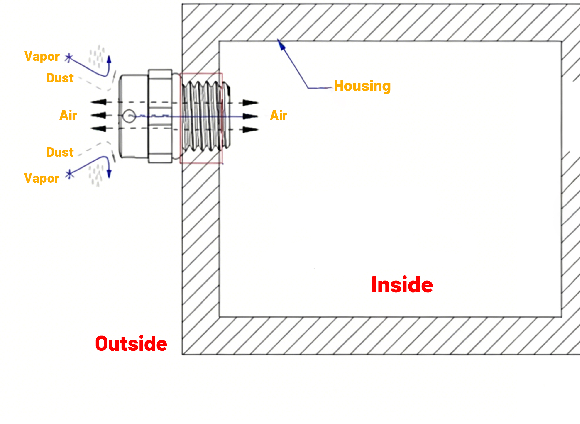
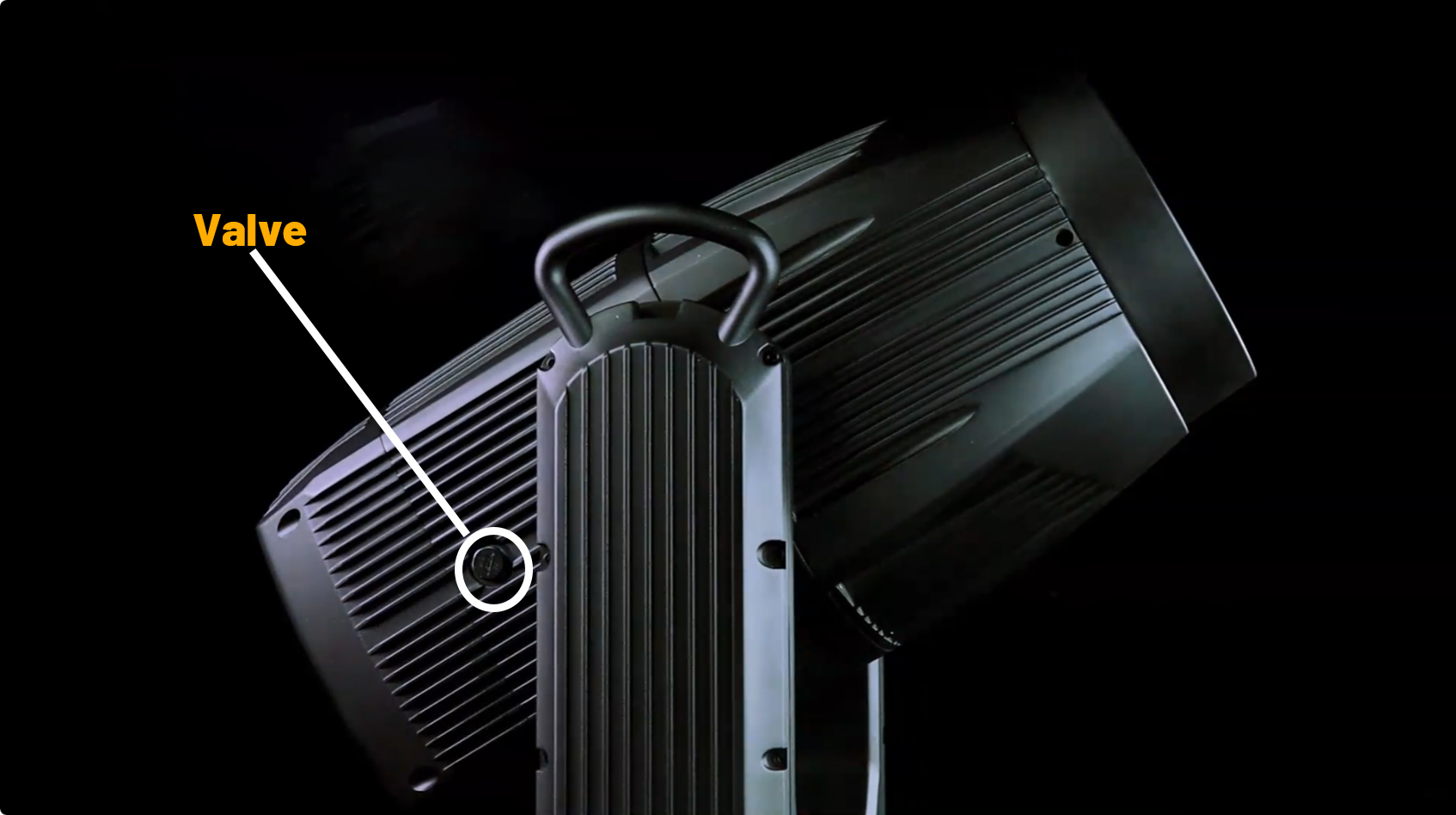
A common misconception is that a sealed fixture is internally dry. The reality is the opposite, and many lighting technological engineers are surprised to learn why. When a light is powered on, the internal air heats up, expands, and is expelled through thread gaps and the waterproof un-directional valve. When it cools down after the show, a negative pressure forms inside, sucking ambient air back in. This "breathing" process doesn't just equalize pressure; it actively pulls in water vapor. A waterproof valve's ePTFE( expanded Poly Tetra Fluoro Ethylen) membrane is excellent at blocking liquid water, but it is permeable to water vapor molecules, creating a one-way path for moisture accumulation. This external ingress combines with a second, internal source: trace moisture absorbed by PCBs, wiring, and structural components during manufacturing, which is baked out during initial high-temperature operation. Now you have a sealed chamber with a wet baseline and a constant intake of humidity. On a humid night after a sudden rainstorm on an outdoor festival stage, internal condensation becomes not a possibility, but a near certainty. Once it appears, the cycle of damage begins.

Based on extensive field failure analysis and R&D, we've found that a truly great outdoor waterproof stage lighting fixture must treat thermal management, humidity control, and structural drainage as one integrated system. The following four design and process pillars form the core of a fixture that preserves its high output for years.
1. Integrated Structural Design for Drainage and Heat Dissipation
The approach begins at the mechanical design stage. Cooling fins should be oriented vertically, with integrated channels at their base to guide any trace water or internal condensate directly to a designated drainage point, away from all electronics. Housing tops must avoid concave depressions, sealing faces should use angled water-shedding lips, and all internal PCBs and connectors must be positioned well above the lowest point in the cavity, often with an assist from hydrophobic coatings. A well-executed drainage design doesn't just lower condensation risk; it also prevents water films from blocking the critical thermal path.
2. A Scientifically Matched Breathable Un-directional Valve — Precise "Breathing Management"
The waterproof valve's airflow rate is not a "bigger is better" decision. It must be precisely matched to the fixture's internal volume, maximum operating temperature, and expected environmental temperature gradients. If the vent's capacity is too low, the intense negative pressure during a rapid cool-down can fatigue seals and literally suck moisture past them. If it's too high, it hyper-ventilates the fixture, flooding it with moist air and saturating internal desiccants in days, rendering them useless. Our approach is to calculate the exact volume of air exchanged in a worst-case thermal shock scenario and select a vent with a membrane area and moisture vapor transmission rate that keeps the internal pressure differential safe while limiting moisture ingress to a level that the built-in desiccant can handle for an entire maintenance cycle. This is a form of precise breathing management that every demanding production team should be able to trust.
3. Deep Drying and Controlled Assembly in Production
The most effective way to eliminate the "built-in" moisture source is a rigorous drying process. Before final assembly, all critical components — LED modules, PCBs, internal wiring, connectors, and certain structural parts — are baked in a precision oven at a sustained temperature of 85–105°C to drive out deeply absorbed moisture. Immediately after baking, assembly occurs in a dry-room environment with humidity controlled below 30% RH. A fresh molecular sieve desiccant pack is placed inside, and the fixture is sealed. This production discipline pushes the internal dew point to an exceptionally low level, creating an unshakeable foundation for a fog-free lighting life.
4. User-Side Proactive Maintenance: Vent Cleaning and Desiccant Renewal
No engineering is ever truly "fit and forget." On the road with concert touring or during a long outdoor festival run, the vent's surface will accumulate dust, grime, and oil, obstructing gas exchange and risking membrane rupture under pressure. Desiccants will eventually reach their adsorption capacity. This is why we emphasize a simple but non-negotiable routine in all our user documentation and training: clean the vent surface regularly with a soft brush— never a high-pressure washer. If a vent membrane appears aged, cracked, or deformed, it must be replaced immediately. Likewise, monitor the internal humidity indicator card and regenerate or replace the desiccant pack at every maintenance cycle. These small, disciplined actions are the final, indispensable line of defense for any professional lighting fixture working in harsh environments.
A fixture that delivers precise, high-impact light night after night on an outdoor festival main stage or a grueling concert touringschedule demands far more than a passing grade on a single IP test. It's a testament to a manufacturer's systemic mastery of thermodynamic management, moisture control, precision assembly, and a deep respect for the entire lifecycle of the product. We share these insights to help every lighting designer, production team, and lighting technological engineer see beyond the spec sheet and understand the genuine engineering value behind truly stable light output. If you're looking for a beam that won't dim, won't fog up, and won't lose its precision in the face of the elements, we're ready to share more of our technology and real-world case studies with you.


